As Ad Creatives Multiply, How to Identify Effective Campaign Directions?
By the time one marketing video is ready for launch, the next batch may have already entered the asset library. As AI shortens production cycles, the pace of asset library updates begins to outpace the workflow rhythms campaign teams were accustomed to.
Bidnex recently launched AlgoVideo, an all-in-one AI marketing video creation platform for cross-border e-commerce that enables rapid generation and adjustment of marketing videos, as well as extension of additional versions based on existing content. For production teams, this means more content can be completed in less time; for campaign teams, however, the influx brings more than just additional assets.
New versions must first be identified and categorized before determining which content proceeds to testing.
As the pace of asset production accelerates, campaign teams face increasingly complex choices.
More Assets Don’t Necessarily Mean Richer Creative Directions
Teams can create multiple visually distinct videos by varying backgrounds, models' attire, or color schemes around the same selling point, but these versions typically convey identical core messages. When videos alter their opening sequences, usage scenarios, or presentation of selling points, campaign teams must observe whether these new expressions resonate with different audience segments.
If teams indiscriminately launch all files simultaneously, limited budgets become fragmented across numerous similar versions. Some assets may get terminated prematurely before accumulating sufficient exposure and conversion samples due to early fluctuations, while others might receive disproportionately favorable initial traffic that inflates short-term performance. While more files enter the pipeline, the actual volume of actionable insights may not increase proportionally.
After receiving a batch of assets, campaign teams should first categorize modification types before establishing test priorities:
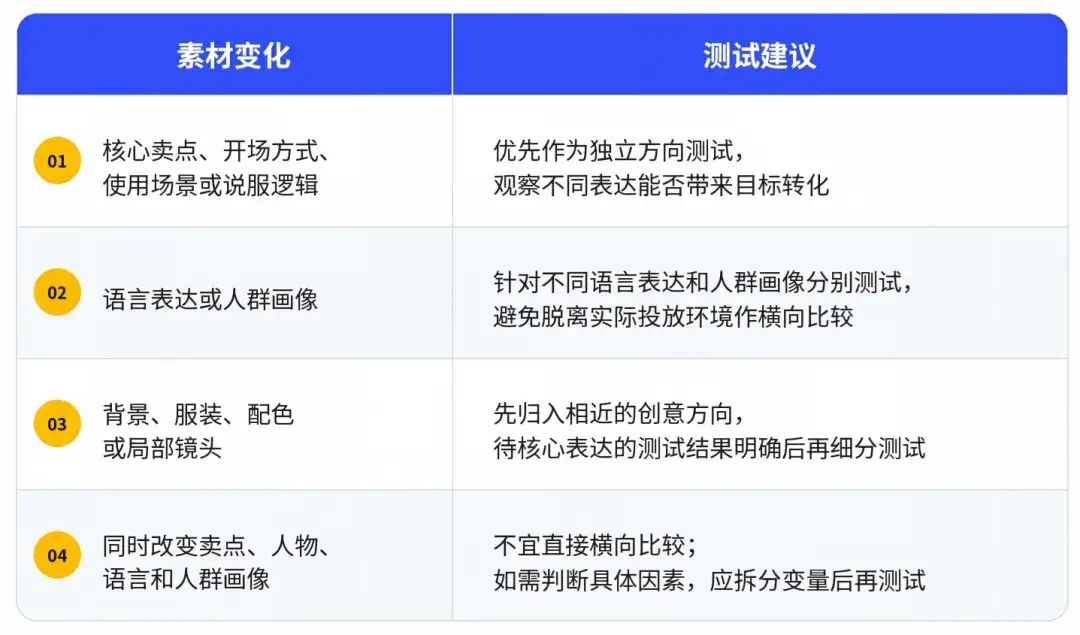
Complex testing frameworks aren't required beforehand, but the primary validation objective for each round must be clearly defined. When purchase is the goal, leading click-through rates alone don't prove asset superiority; when targeting registrations or traffic acquisition, evaluation criteria must shift accordingly. Without clear campaign objectives, every version might excel in some metric while teams remain unable to determine subsequent budget allocation.
Asset Performance Must Be Evaluated Within Context
Suppose Asset A shows significantly higher click-through rates than Asset B. Based solely on this metric, campaign teams might easily conclude A performs better. However, deeper analysis of traffic sources and conversion outcomes may reveal: A's impressions concentrate primarily on mobile traffic in one market, while B appears more frequently in another market or on different device types; though A generates more clicks, B might drive more registrations and purchases.
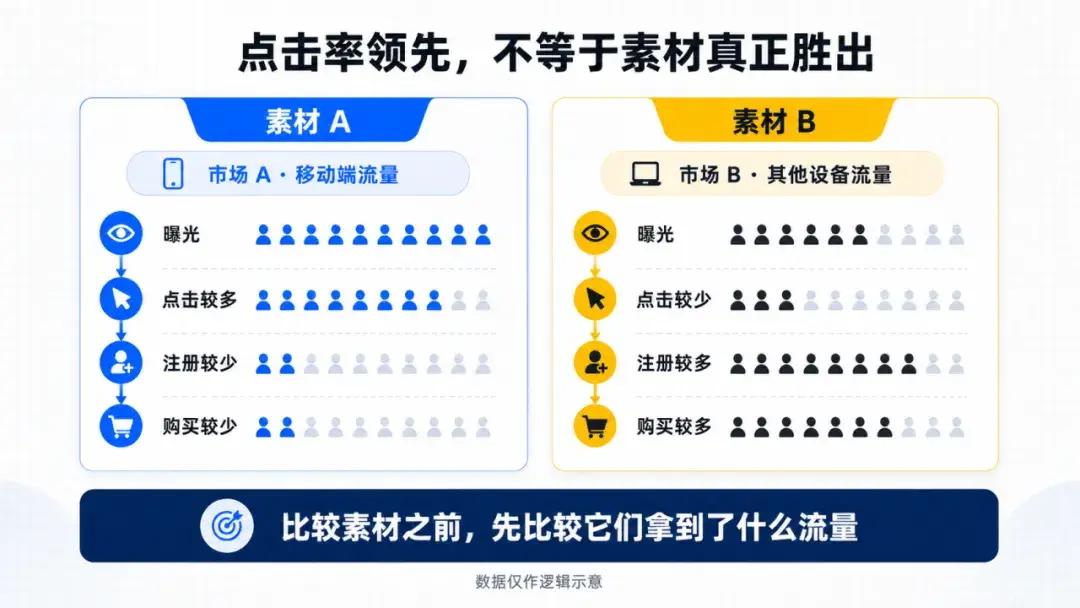
Real-world campaigns rarely control all variables as strictly as controlled experiments. Even with identical assets, different campaign environments can yield divergent results. Without factoring in audience segments, media sources, devices, and timing during analysis, teams may mistakenly attribute traffic differences to creative effectiveness.
Such misjudgments can steer optimization down incorrect paths. Teams might interpret superficial metric advantages as evidence of overall creative superiority, or generalize short-term success in specific traffic segments as universal effectiveness. By the time deeper conversions fail to materialize, earlier misjudgments have already influenced budget allocation.
Sample size and observation duration are equally critical for budget decisions. New assets with limited initial samples often show volatile metrics from minor conversion fluctuations; if conversion data experiences reporting delays, premature discontinuation might underestimate true performance. Consequently, short-term leadership shouldn't justify scaling, nor should early underperformance warrant immediate termination.
Bidnex DSP optimizes for deeper events like installations, registrations, and payments. During analysis, teams can examine how these key actions perform across audience segments, media sources, and devices, while leveraging anti-fraud mechanisms to minimize noise from invalid traffic. This approach clarifies whether performance differences stem from creative quality or specific campaign conditions.
Post-Testing, Creative Directions Require Strategic Selection
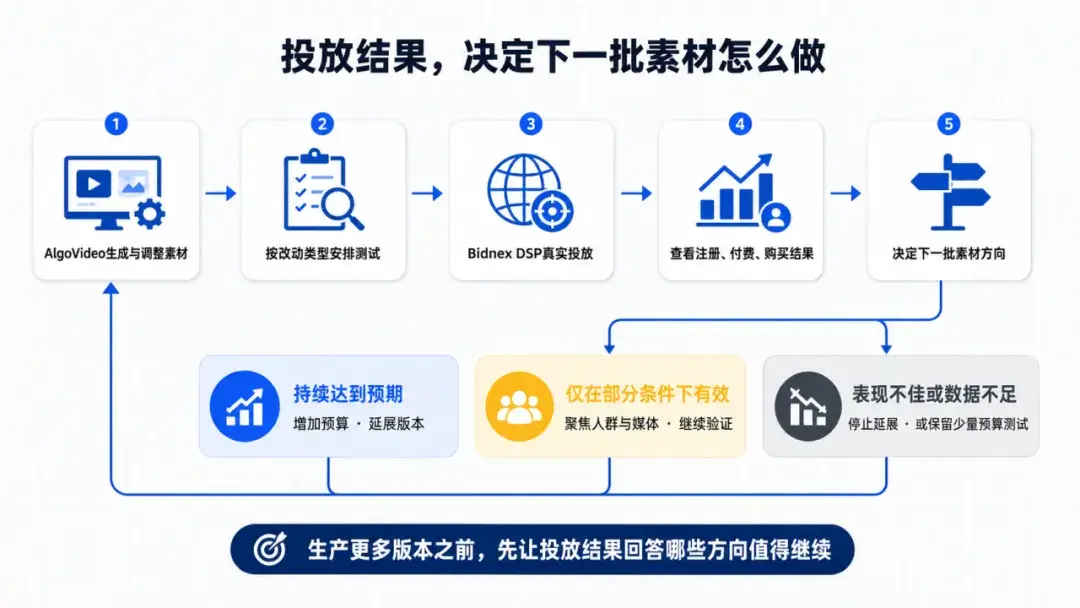
After accumulating sufficient data from a testing round, campaign teams should document more than just asset rankings and budget adjustments—they must specify which elements production should retain, discard, or continue validating.
Simply stating "Asset A outperforms Asset B" remains too vague. Analysis should identify which specific content change drove results, whether advantages manifested in clicks, registrations, or purchases, and in which markets, audience segments, and media environments these conclusions hold. Otherwise, production teams may replicate entire videos as templates without isolating the actual conversion drivers.
These insights should inform the next production brief: elements to preserve, conclusions applicable only to specific campaign conditions, and directions requiring further validation. Production teams then extend only necessary variations accordingly.
Directions that consistently underperform across multiple testing rounds with sufficient data should be removed from future production lists; those with inadequate data warrant retention of only representative versions for continued observation. Through successive rounds, teams progressively identify what content merits continuation and under which conditions, eliminating the need for production teams to start from excessive speculation.
When production cycles were lengthy, teams prioritized solving the "do we have it" problem.
Today, with generation tools enabling faster reworking, rewriting, and expansion of content, teams must answer: Which content deserves to stay?
This redefines efficiency metrics. Producing more videos merely indicates increased capacity; the true measure of this acceleration lies in whether teams can identify effective content faster within the same budget and timeframe.
Generation tools continuously expand content possibilities, while the market narrows possibilities through real-world feedback. As assets become increasingly abundant, interpreting post-campaign data becomes the critical challenge.