Industry Insight | As Peak Season Approaches, How Should SSPs Optimize Request Allocation and Revenue Assessment?
As the fourth quarter approaches, brands are beginning to plan their advertising campaigns for Black Friday and the year-end shopping season. Budget allocation across regions, ad formats selected, and time slots targeted will all influence the media resources buyers will require next, necessitating a review of SSPs' existing request dispatch arrangements.
Facing a single media impression opportunity, a Supply-Side Platform (SSP) can send bid requests to multiple Demand-Side Platforms (DSPs), with each buyer deciding whether to bid. Prior to peak season, SSPs should first review supply paths and integration status, then form an initial dispatch scope based on current buyer demand and historical performance; subsequently refine the strategy according to actual bidding performance, and validate through publisher revenue whether expansion is warranted.
01: First Verify Buyer Demand and Integration Status
BidSwitch's Q4 business recommendations released in September noted that when a single impression passes through multiple SSPs, exchanges, or resellers, duplicate requests may occur. Redundant requests increase processing burdens and may prevent DSPs from returning bids within stipulated timeframes. [1]
Therefore, low bid response rates from a DSP should not be immediately interpreted as lack of demand. Before adjusting dispatch scopes, SSPs should first check for redundant forwarding in supply paths and verify interface operations, response deadlines, and timeout situations to avoid misdiagnosing integration issues as demand mismatches.
After resolving integration issues, SSPs must confirm whether existing dispatch scopes align with current buyer demand. By analyzing historical bid records and current campaign plans, SSPs can determine which requests should continue and which can be reduced.
Beyond historical data and routine communication, buyer-provided filtering criteria can also inform pre-dispatch decisions. The Dynamic Traffic Engine (DTE) provides an open-source framework for this practice. In April 2026, IAB Tech Lab announced acceptance of Amazon Ads' donation of the DTE project. [2] Within this framework, DSPs provide filtering criteria and configurations; SSP-side components regularly retrieve this information to evaluate whether specific ad opportunities meet a DSP's requirements before dispatch, enabling SSPs to filter or forward requests accordingly. [3]
This allows buyer information to inform SSP dispatch decisions earlier in the process; DSPs still independently decide whether to bid upon receiving requests. Pre-dispatch evaluation targets specific DSP acceptance criteria rather than overall media quality assessment; SSPs must still determine independently whether to send requests to other buyers to preserve their bidding opportunities.
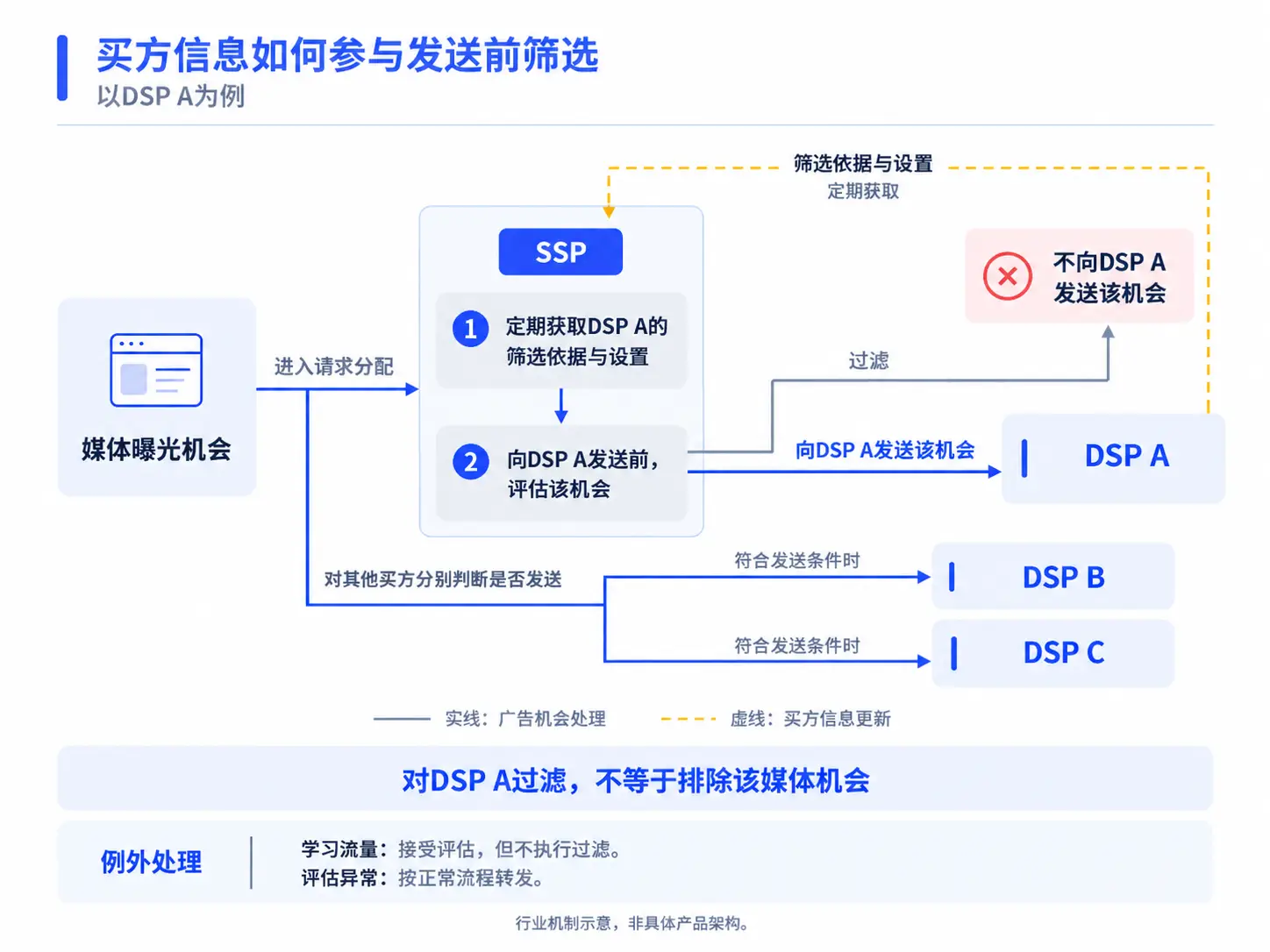
Dashed lines indicate periodic buyer information updates; solid lines represent ad opportunity processing.
02: Adjust Request Allocation Based on Buyer Performance
When reconfiguring requests before peak season, dispatch scope shouldn't be determined solely by overall DSP bid response rates. Consider this hypothetical scenario: sending 100 requests to a DSP yields 10 bids (10% response rate); reducing to 50 requests still yields 10 bids (20% response rate). While bid quantity remains unchanged, whether publishers benefit depends on whether these bids can participate in subsequent competition and ultimately generate impressions and revenue.
A paper published on arXiv in August 2026 provides experimental references for such request allocation. Researchers conducted four rounds of online experiments on a platform processing over 20 billion daily requests, including one round involving simultaneous adjustment of multiple DSP request strategies.[4]
Rather than uniformly filtering requests based on DSPs' overall response rates, the research team combined current impression opportunities, likelihood of DSP bid returns, expected bid levels, and competitive context to evaluate the participation value of each request for different DSPs, then dynamically adjusted dispatch probabilities. This refined request allocation judgment from "how a DSP performs overall" to "whether this specific resource merits dispatch to that DSP".
In multi-DSP experiments, the platform created strategy and control groups through fixed traffic splitting: the strategy group used new allocation methods while the control group maintained existing production approaches. Researchers evaluated performance using Ratio-DID (ratio difference-in-differences), calculating metric ratios before and after implementation for both groups, then comparing ratio changes to estimate the new strategy's relative impact while minimizing interference from pre-existing group differences and market fluctuations.
According to this methodology, during the 14-day observation window after initial adaptation,DSP request volume decreased by 34.2%, DSP response volume only declined by 6.7%, and the response-to-request ratio increased by 41.8%. This indicates that despite significantly reduced request volume, most buyer responses were preserved, with the platform reporting improved overall monetization results.
The paper concludes that attention should focus on the quality of buyer participation rather than merely expanding request volume. On their platform, prioritizing requests to DSPs expected to contribute meaningfully to auction outcomes achieved both reduced request volume and improved monetization performance.
Table 6 in the paper presents overall multi-DSP experiment results; Tables 8 and 9 further reveal that changes across resource tiers and DSPs were inconsistent: some DSPs returned more responses after request reductions, while others showed changes primarily in bid levels and subsequent billing performance. Behind the aggregate data likely lie different demand structures and competitive pathways.
The previously mentioned DTE demonstrates how SSPs can use buyer demand signals for pre-dispatch filtering; this research further illustrates that platforms must also form specific allocation judgments based on actual transaction performance. For DSPs with low overall response rates, SSPs can identify regions, ad formats, or resource tiers where they still provide effective responses and competitive bids, preserve valuable request combinations, and gradually adjust other segments.
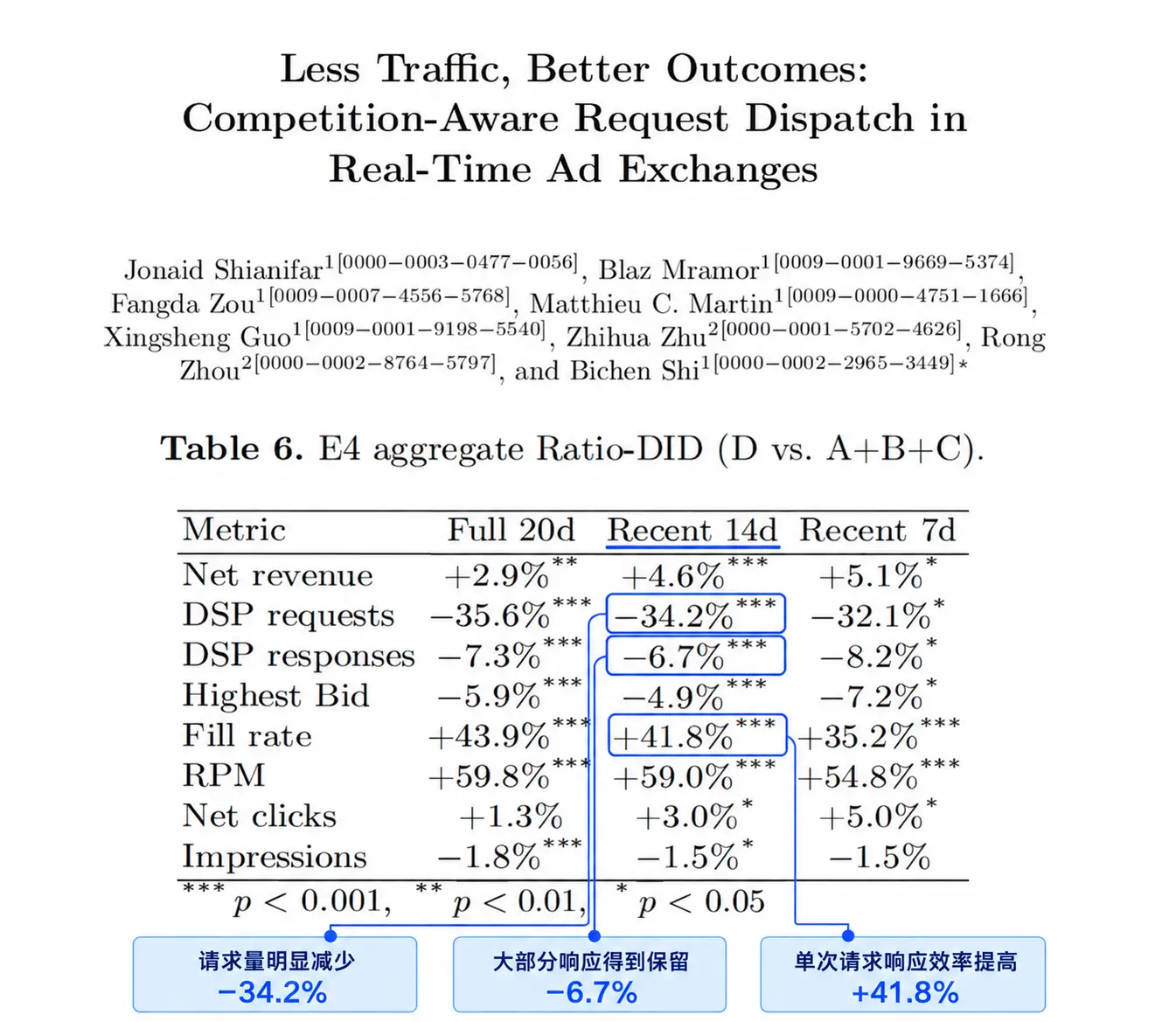
Source: Shianifar et al., arXiv:2608.03705v1, Table 6.
Data represents Ratio-DID estimates from the 14-day window following strategy implementation.
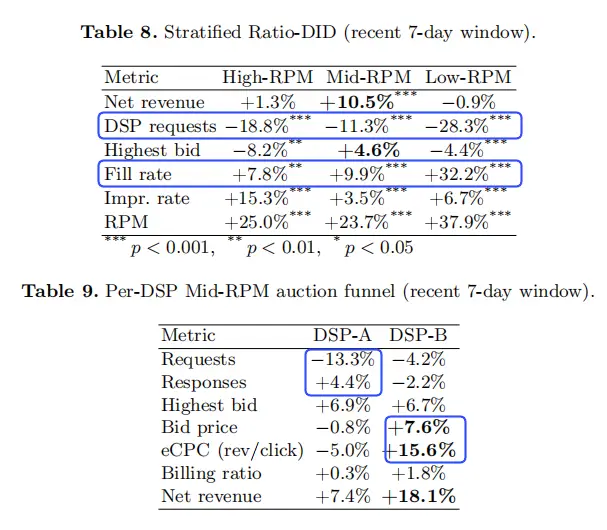
Top: Strategy effects across traffic tiers (Table 8). Percentages represent Ratio-DID estimates showing relative metric changes in the strategy group versus control group before and after implementation.
Bottom: Changes in request, response, and transaction metrics for DSP-A and DSP-B within Mid-RPM traffic (Table 9).
"Recent 7 days" in both table titles refers to the observation window following strategy implementation.
Source: Shianifar et al., arXiv:2608.03705v1.
Bidnex SSP | Demand Matching and Request Allocation
Bidnex SSP analyzes traffic and ad demand characteristics in real-time to optimize matching strategies and intelligently dispatch traffic, prioritizing allocation to buyers with higher bids or more stable fill rates. The platform predicts buyer response rates to automatically switch to alternative buyers, minimizing traffic waste.
03: Validate Revenue Before Scaling Adjustments
While the paper provides experimental references for request allocation, SSPs must verify whether reducing requests to specific DSPs impacts overall publisher revenue. During promotional periods, both buyer demand and publisher traffic fluctuate; comparing revenue before and after adjustments alone cannot distinguish whether changes stem from dispatch strategies or concurrent market shifts. Therefore, select specific DSPs and publisher resources, splitting comparable traffic into test and concurrent control groups running new and original strategies simultaneously. Groups should maintain similar regional and ad format compositions.
Before testing, clearly define observation periods, evaluation criteria, and metrics including publisher revenue, fill rates, buyer bid performance, request volume, timeout rates, plus traffic authenticity and creative quality. Request volume and timeouts indicate processing performance; cost changes require separate calculation using actual computational resources and expense data.
When dispatch strategies use buyer-provided filtering criteria, establish clear protocols for information updates, expiration timelines, and fallback mechanisms for original dispatch arrangements during anomalies.
Revenue evaluation must cover all test-participating impression opportunities. After reducing requests to a DSP, corresponding opportunities may still be fulfilled by other buyers—thus revenue from alternative buyers must be included; unfilled opportunities, while non-revenue generating, remain within the test scope. Evaluating only dispatched or ultimately filled opportunities would overestimate post-adjustment performance.
After defining statistical scope, verify comparable regional and ad format compositions between groups, and monitor whether these compositions shift significantly during observation. For example, if test groups primarily contain video resources while control groups focus on banner resources, income differences cannot be immediately attributed to request dispatch strategies.
During comparison, first examine revenue per equivalent impression volume for similar resources; when consolidating overall performance, merge results using identical regional and ad format weightings. Uniform weighting serves only statistical comparison and doesn't alter actual traffic distribution.
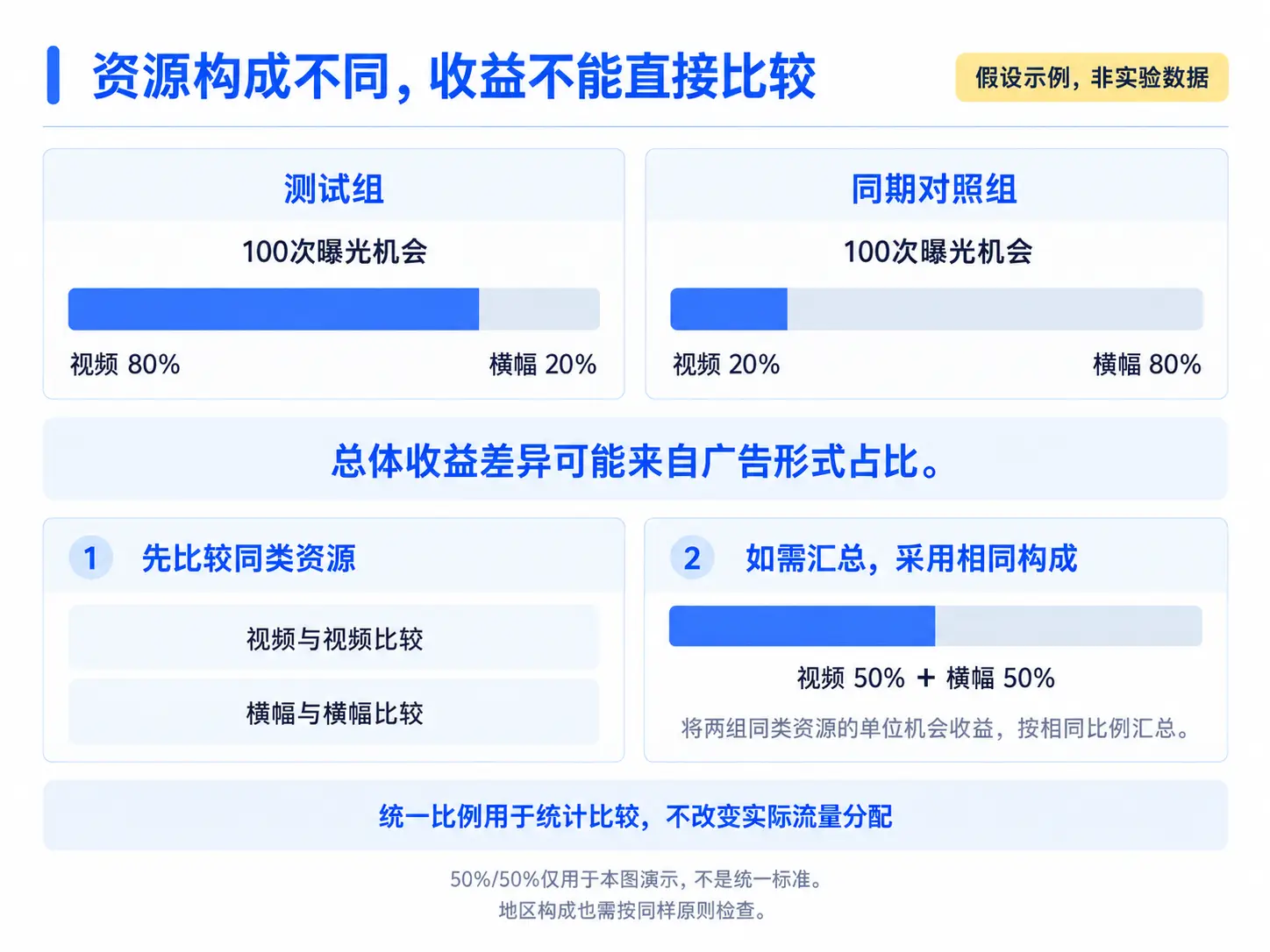
Illustrative resource composition comparison; proportions shown are hypothetical examples.
Even with comparable resource compositions, groups may contain different impression volumes. While total publisher revenue reflects actual business outcomes under real traffic conditions, direct comparison of total revenue remains influenced by traffic scale; revenue per equivalent impression volume must also be examined.
When calculating revenue, both groups should use publisher-platform pre-agreed definitions and deductions consistent with actual business practices—never mix estimated and settled revenue. Revenue must be attributed to the test opportunities that generated it; delayed reporting and subsequent adjustments should follow consistent rules to prevent misattribution across test groups or observation periods.
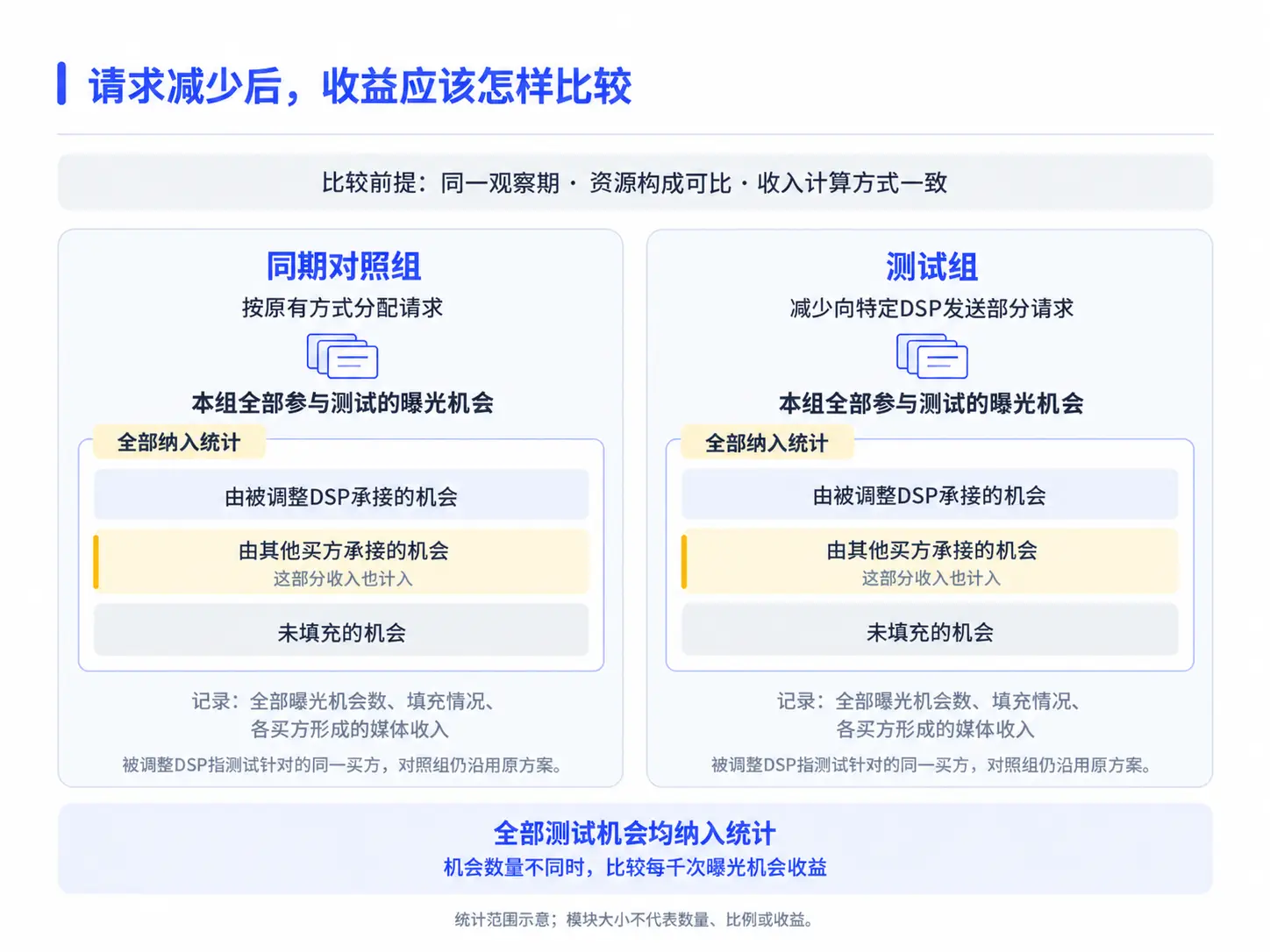
Illustration of revenue comparison across different opportunity volumes
Based on this, publisher revenue can be normalized to per-thousand impression opportunities: Publisher Revenue per Mille (RPM) = (Group revenue ÷ Group impression count) × 1000. This standardization enables comparison of revenue potential per equivalent impression volume regardless of group size. Total revenue and normalized metrics should be considered together rather than interchangeably.
After testing, judgment should follow pre-defined evaluation criteria. If publisher revenue meets requirements across the complete test scope, request volume and timeout performance align with expectations, and quality checks reveal no anomalies, adjustments can be gradually expanded. If revenue declines, processing performance falls short, or quality issues emerge, the adjustment scope should be reduced, potentially reverting to original allocation.
Bidnex SSP | Transaction Monitoring and Quality Assurance
Bidnex SSP provides transparent reporting for transaction performance visibility. The platform integrates proprietary real-time monitoring systems with third-party anti-fraud verification services like HUMAN and Pixalate to validate traffic authenticity; simultaneously, its proprietary AI visual engine automatically identifies and blocks fraudulent or malicious ad creatives.
04: Conclusion
With Black Friday and year-end shopping season approaching, changes in brand campaign planning will reshape buyer demand for different media resources. SSPs must review request dispatch scopes accordingly—reducing unnecessary requests while preserving opportunities for other buyers. Whether adjustments warrant expansion ultimately depends on publisher revenue performance across the complete test scope.
Bidnex SSP focuses on publisher monetization through demand matching, request allocation, and transaction quality management. Contact the Bidnex team to discuss customized collaboration and optimization strategies based on your media resources, buyer demand, and revenue performance—ensuring peak season readiness.
References
[1] BIDSWITCH. Tune-up your bidstream pipes: The Q4 checklist for buyers and sellers[EB/OL]. (2026-09-16)[2026-09-18].
[2] IAB TECH LAB. IAB Tech Lab announces Dynamic Traffic Engine donation from Amazon Ads to improve bidstream efficiency[EB/OL]. (2026-04-15)[2026-09-18].
[3] IAB TECH LAB. Dynamic Traffic Engine: Get started[EB/OL]. Version 2.4, 2026-06-01[2026-09-20].
[4] SHIANIFAR J, MRAMOR B, ZOU F, et al. Less traffic, better outcomes: competition-aware request dispatch in real-time ad exchanges[EB/OL]. arXiv:2608.03705v1 (2026-08-04)[2026-09-20]. DOI:10.48550/arXiv.2608.03705.